Canada slashes 100% tariffs on Chinese EVs to 6%
Canada has agreed to allow an annual quota of 49,000 Chinese electric vehicles into the country at the tariff rate of just 6.1%
https://electricautonomy.ca/data-trackers/ev-sales-data/2025...
Canada recorded 45,366 new zero-emission vehicle registrations in Q3 2025, accounting for 9.4 per cent of all new vehicle registrations in the quarter, according to the latest report from Statistics Canada.
Of the total, 26,792 units were battery-electric vehicles (BEVs), while 18,574 were plug-in hybrid electric vehicles (PHEVs).
So this would represent about 1/4 of current annual EV sales.
For the average family, being able to spend significantly less on a car is a big deal.
But all the policy support that would have let North American automakers build up a competitive position with China is gone, so this is more about just acknowledging reality now.
It’s tough to convince most price-inelastic people they shouldn’t buy a car that is 1/2 price, even if it has fewer features.
Edit: to be clear I meant that the US did not compete, not that they could not compete
Yeah thee was never any competing with china, our industry just relies on our market using different values to purchase a car.
This is patently false. The US could have competed with China if it had maintained investments spinning up battery manufacturing and downstream systems to build EVs at scale, while subsidizing EVs (fossil fuels are subsidized to the tune of hundreds of billions of dollars per year[1]) and increasing taxes on combustion mobility. The US picked legacy automaker profits and fossil fuel interests instead, simply out of lack of will and short term optimization over long term success.
China is building under the same rules of physics as everyone else. You can choose not to, but that is a choice.
(I believe in climate change, so I am thrilled China is going to steamroll fossil fuel incumbents out of self interest[2][3], regardless of negative second order effects; every 24 months of Chinese EV production destroys 1M barrels/day of global oil consumption at current production rates, as of this comment)
[1] https://www.imf.org/en/topics/climate-change/energy-subsidie...
[2] https://ember-energy.org/data/china-cleantech-exports-data-e...
China has gone all-in on EVs because over the years they smartly built up the world's best rare earth refining capabilities and immense manufacturing prowess while the United States has undoubtedly secured the global oil supply (remember tanks and fighter jets to fight wars aren't running on batteries) which, even amongst the doomiest of doomers will last quite a while.
China was never going to be an oil-producing powerhouse, but it did have the ability to leverage alternative energy sources so that it wasn't quite as beholden to the petrodollar institution, so that is what they did. And of course running cars on batteries and doing so at a very cheap cost makes sense there.
Meanwhile, the US can obviously produce good cars at a good enough price and with cheap oil for the foreseeable future it's hard to argue in favor of EVs as a national policy. What, we're going to switch to EVs? Who is going to build them? Tesla? We don't have access to the rare earth refining capabilities to meet demand. It's just physics. And if China is using less oil, that means more for the United States and others.
As you said, China has taken these actions out of self interest, but the self interest isn't "clean environment" or anything like that, it's just down to being not as reliant on the US for energy. Though that's a nice benefit. I do own an EV and I think the driving experience is superior but geopolitically things seem to be trending in a different direction.
Meanwhile, the US can obviously produce good cars at a good enough price and with cheap oil for the foreseeable future it's hard to argue in favor of EVs as a national policy. What, we're going to switch to EVs? Who is going to build them? Tesla? We don't have access to the rare earth refining capabilities to meet demand. It's just physics. And if China is using less oil, that means more for the United States and others.
This is false. The US has chosen to produce expensive (average new vehicle price is $50k), fossil combustion vehicles to the detriment of its population. I want a cheap EV. I will buy a cheap EV from a US automaker. They do not want to sell cheap EVs. The US won't allow me to buy excellent, cheap Chinese EVs. The US population is being held economically hostage for legacy automaker profits and the fossil fuel industry. Why should the US consumer collectively have to pay more for these low quality decisions? I am incentivized to root for the destruction of US legacy auto so that I can eventually get a high quality, inexpensive Chinese EV, because that will be all who is left building them. China sells more EVs than the US sells entirely. It is only a matter of time as they continue to spin up manufacturing.
Whatever it takes to get cheap EVs with the sharpest deployment trajectory possible, I am not particular, regardless of the harm it incurs on US automakers or the US itself (if unwilling to build EVs, which appears to be the case). Climate change does not care about nation state boundaries. Certainly, if you don't believe in climate change, or don't believe it to be pressing, there is no discussion to be had.
New data: EVs grew more in ’25 than ’24, despite constant lies saying otherwise - https://electrek.co/2026/01/14/contrary-to-popular-belief-ev... - January 14th, 2026
The World Hit ‘Peak’ Gas-Powered Vehicle Sales — in 2017 - https://www.bloomberg.com/news/articles/2024-01-30/world-hit... | https://archive.today/p2hl1 - January 30th, 2024
This is false.
It's not false. See Honda, Toyota, &c. many models are made in the US by Americans even if they're Japanese companies.
The US has chosen to produce expensive (average new vehicle price is $50k), fossil combustion vehicles to the detriment of its population.
The US industry regardless of reason isn't going to be able to make a cheap, high-quality EV because it doesn't have access to affordable refining capabilities due to various reasons. So the actual situation is, sure the US could let China ship in a bunch of awesome EVs, but then the US automakers will suffer and some will go out of business and then the US just won't be making cars and those union autoworker jobs will be gone. Some people are fine with that I guess, but strategically it doesn't make a lot of sense for the US to allow the domestic auto industry to be crushed. Same thing with Germany. The EU is already starting to roll back EV mandates[1] for the same reason the US is focusing back on oil and natural gas.
Whatever it takes to get cheap EVs with the sharpest deployment trajectory possible, I am not particular, regardless of the harm it incurs on US automakers or the US itself
On the other hand, as an American voter and even an EV driver, I disagree with these actions. EVs at all cost isn't a goal that makes sense or that I'm interested in. A better argument is to just do away with cars entirely. EVs still create c02, require toxic processing of materials and components, and while they're better for the environment, they're not as good as walking or transit.
[1] https://www.reuters.com/business/autos-transportation/eu-rel...
On the other hand, as an American voter and even an EV driver, I disagree with these actions. EVs at all cost isn't a goal that makes sense or that I'm interested in. A better argument is to just do away with cars entirely. EVs still create c02, require toxic processing of materials and components, and while they're better for the environment, they're not as good as walking or transit.
Well, you're arguing this in the wrong country. You might check your priors. I regret to inform you that only about 5% of Americans use public transit[1][2][3], and that is unlikely to change unless there is a sea change of migration towards urban areas from the suburbs and rural areas.
A majority of US miles are driven in rural areas or areas without mass transit[4], and the sun belt, where there is limited to no public transit, holds roughly half of the US population. I certainly agree to destroy demand for light vehicle passenger miles in urban areas with robust public transit and other non vehicle options, but the rest of the US will require EVs of some sort. Most of the US does not have mass transit infrastructure, and won't for the remainder of most of our lives (as of this comment).
[1] https://vividmaps.com/wp-content/uploads/2023/09/public-tran...
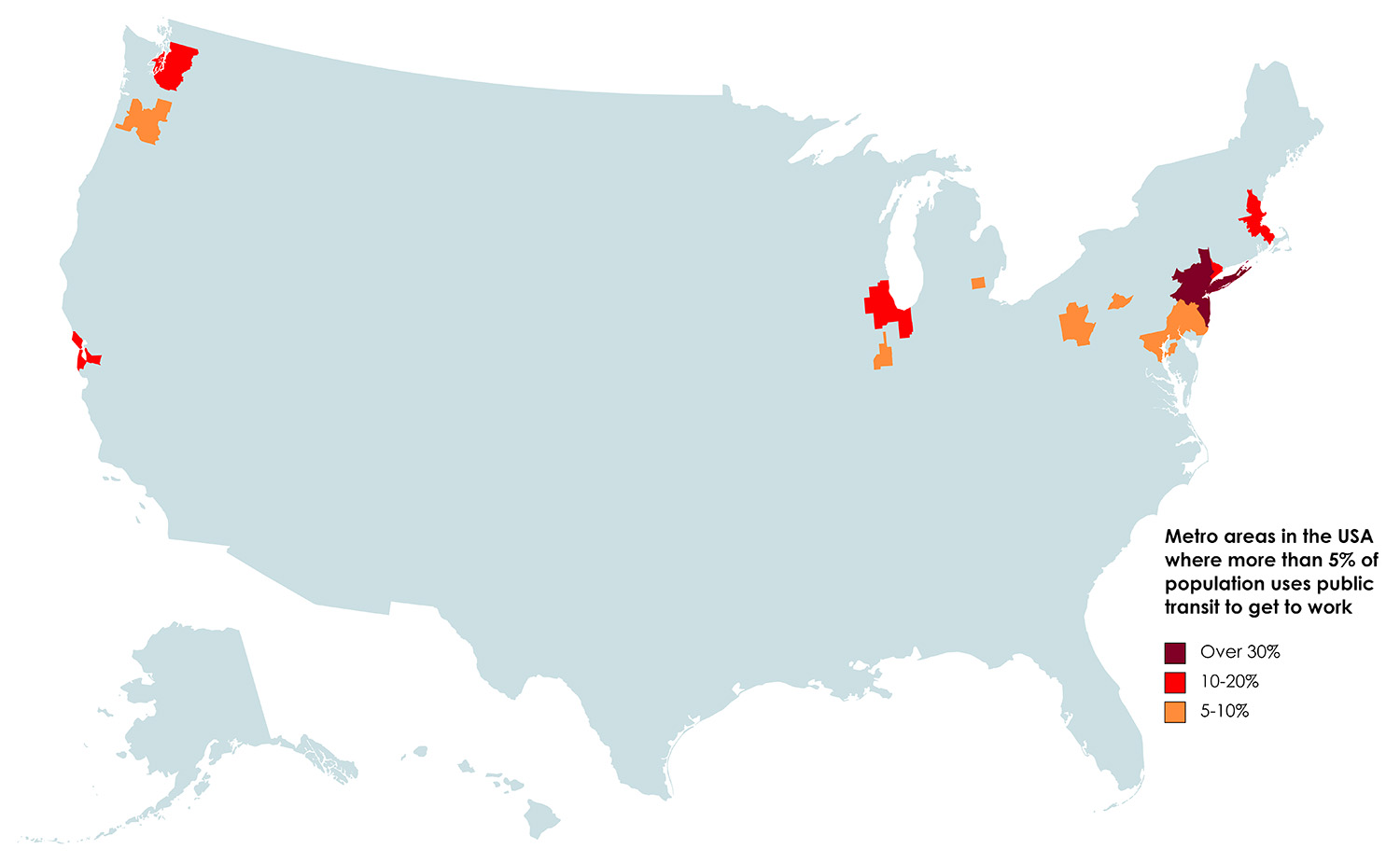
[2] https://vividmaps.com/public-transportation-in-the-united-st...
[3] https://www.census.gov/newsroom/press-releases/2021/public-t...
[4] https://www.bts.gov/geography/geospatial-2/daily-vehicle-mil...
Well, you're arguing this in the wrong country. You might check your priors. I regret to inform you that only about 5% of Americans use public transit[1][2][3], and that is unlikely to change unless there is a sea change of migration towards urban areas from the suburbs and rural areas.
Yes… I’m aware. I’m arguing for change in that figure. Part of the reason American cars are so expensive is because as an industry manufacturers can raise prices because there are no alternatives to car ownership.
The US won’t require EVs for any purpose anytime in our lives. We don’t have the processing and manufacturing capacity to build them here, and we won’t allow our auto industry to go defunct either. It’ll be gasoline for the foreseeable future. Not necessarily a future I like as an EV owner but that’s how things look today. Winning a war is more important than the climate, unfortunately.
China has gone all-in on EVs because over the years they smartly built up the world's best rare earth refining capabilities
If by that you mean they propped up their industry and undercut everyone else until they went out of business, then increased prices to a point just below where it would be profitable for someone else to try again?
Then use their monopoly position to further their interests in other sectors?
Edit: Which I may note is probably the same strategy being applied here as well.
Even if the money is spent properly, it's still highly criticized. I can't tell you how many times I've seen people complain that Tesla was only successful because of massive government grants.
Am I off base here?
The thing about China is that they’re more strategic with their money and have longer timelines and clear, achievable visions. If you read the Wikipedia page for Made in China 2025 you’ll get the wrong impression that their success is due to more recent pushes; the vision is far more universal and has existed for far longer. You don’t get to the forefront of advanced manufacturing from nothing in ten years. Look at the 5th and 6th Five-Year Plans, into the seventh… you see the groundwork laid for present day China. The US rarely does that sort of long term thinking or planning these days, and it’s not even about the political winds changing or short-termism as much as that we lack one unified vision. Without that unified vision you can’t plan long term and you also can’t correct glaring problems. For example, if we had a unified vision on manufacturing, an obvious issue would be the lack of an American JLCPCB. You could create one with a stick and carrot approach, tariff assembled PCBs, new rule that any imported assembled PCB has to prominently display “electronics made in China”, smart subsidies for US board houses that encourage scaling and cost reduction. But that level of cohesion and vision rarely happens in the US and so we get a chaotic hodgepodge.
The new bottom has been moving to Vietnam, etc.
https://en.wikipedia.org/wiki/Five-year_plans_of_China
https://en.wikipedia.org/wiki/Made_in_China_2025
https://en.wikipedia.org/wiki/State-owned_Assets_Supervision...
Dan Wang: 2025 Letter - https://news.ycombinator.com/item?id=46454413 - January 2026 (323 comments)
(Dan Wang’s book, Breakneck [https://danwang.co/breakneck/], is excellent and I highly recommend on this topic as others do in the above thread)
And, to be clear, that does not mean you need to get rid of union US labor. It just means the existing folks can do more with the same number of folks they have today, and the pipeline for new workers can shrink while maintaining productivity (and we're going to need those folks for other jobs automation cannot do; trades, electrical grid and renewables infra, nursing and care, etc). This does require both unions and corporations to partner in good faith and share in the gains from this operating model, versus the traditional "squeeze labor as hard as you can for shareholder gains and management comp." If we get to the point where a just transition is needed (like coal mining and generation), that is a policy problem; make good policy, be humane to the human, package them out appropriately if we scale automation faster than expected.
This is simply smart policy as the world reaches peak working age population and heads towards depopulation over the next century[3][4]. Labor will only get more expensive over time as demand exceeds supply[5]. The capital is there, simply look at annual legacy auto profits; they choose profits over investing in the business, and that is a choice.
[1] Inside China's 'dark factories' where robots run the production lines [video] - https://www.youtube.com/watch?v=ftY-MH5mdbw - December 4th, 2025
[2] Chinese EV makers accelerate robotics drive for ‘game-changing’ edge over US - https://www.scmp.com/business/china-evs/article/3333310/chin... | https://archive.today/sJKKv - November 19th, 2025
[3] The Demographic Future of Humanity: Facts and Consequences - https://www.sas.upenn.edu/~jesusfv/Slides_London.pdf - May 31st, 2025
[4] Mapped: Every Country by Total Fertility Rate - https://www.visualcapitalist.com/cp/mapped-countries-by-fert... - December 22nd, 2025
[5] HN Search: labor shortages - https://hn.algolia.com/?dateRange=all&page=0&prefix=false&qu...
(TLDR Increase productivity with automation to compete with others who already have, buy robots, not share buybacks)
On a huge number of products in the US there is little to no US competition. Instead of using product means (build it better) they use capital means (use your size to get loans to buy up anyone that looks like they could compete in the future).
Lots of US companies minimize actual competition via civil contracts. Cola companies are a great domestic example of this. You give them all the space they want and crowd out competition or you get 'standard pricing', which is way more.
A sizeable portion of the large US companies moved away from making products to printing money via becoming a financial institution. Car companies are a notorious example.
Simply put making products is a side gig, rent seeking is the primary goal. Until we kill that off, we're in for a worsening level of hurt.
Chinese manufacturers have an average labour cost per vehicle of $585. American manufacturers have an average cost of $1341.
You can't buy an equivalent American EV for an extra $756.
Source: https://afia.pt/wp-content/uploads/2025/06/labor-cost-per-ve...
Also, Chinese auto factories are heavily automated now, even when compared to American auto factories.
If all you have in town is a target, that’s where people will shop. If you open up a goodwill there might be some handwringing and “I would never” rhetoric. But many people will go to the goodwill even if they don’t admit it.
*To roughly quantify, I'd say mid-to-late 80s Ford/GM car, not 70s Ford/GM car. It never stranded me, but it did break a few times in inconvenient fashion.
- A move to automate auto factory lines in Chinese auto factories. Up until about a decade ago the emphasis was still on using human labor, and quality took a hit accordingly. Robots are much more precise and consistent, the quality difference between a Chinese-made cars and the same kind of car made in Japan was huge.
- EVs. EV motors are just more reliable in general, and are easier to replace when they wear out or are defective. You don't have so many moving parts any more, and the Chinese became world leaders in battery tech.
If I ever live in China again and need to buy a car, it will definitely be an EV. Heck, I would never buy a BMW ICE (maintenance sucks) but I bought a BMW EV...
Keep in mind that the US auto industry is also very much a Canadian one.
As someone who's worked in the auto industry (in Canada) I have to 'hard disagree.' The big three have proven time and time again that we (Canadians) are second-class citizens when it comes to how they operate the facilities built here. Even before any of this nonsensical tariff nonsense, billions in government money has been given to the likes of Stellantis and GM over the years in an effort to keep jobs in Canada, with them putting in the bare-minimum effort to satisfy people in the short-term and thanking us by continuing their movement of production out of the country. Instead of trying to talk the president down from his pointlessly harmful tariffs, or doing what Toyota/Honda have done in pivoting to building worldwide models beside the domestic ones, the big three are gleefully taking the opportunity to expedite the closure or downsizing of facilities here.
Outside of the chuds who 'need' a pickup truck to satisfy their fragile ego, sales of "American" vehicles are starting to drop, with buyers choosing domestically-produced where possible (like the Toyota Rav4, Lexus NX/RX, or Honda Civic/CR-V).[0]
[0] https://ca.investing.com/news/economy-news/market-share-of-u...
billions in government money has been given to the likes of Stellantis and GM over the years in an effort to keep jobs in Canada, with them putting in the bare-minimum effort
You could replace "Canada" with the "United States" and it's equally true. They aren't treating you any different than us.
Now we have U.S. automakers who are derefential to the current regime's leader and are pulling out. The Federal and Ontario government both tried to somehow make them happy, but you can't make that kind of monster happy. So it's time to move on.
the US auto industry is also very much a Canadian one
Trump's message is loud and clear. The Canadian Prime Minister has said, "the past relationship with the US is over."
https://www.bbc.com/news/articles/c5y41z4351qo
The US President: "US does not need cars made in Canada; free trade deal is irrelevant"
https://www.ctvnews.ca/canada/article/we-dont-need-cars-made-in-canada-trump-says-calls-cusma-irrelevant/
https://www.pressreader.com/canada/sentinel-review-woodstock/20260116/281629606665800I feel Canada only set tariffs on cars out of some deference to the US auto industry
That is exactly what they did.
https://financialpost.com/commodities/energy/electric-vehicl...
The tariffs follow a May announcement by U.S. President Joe Biden of 100 per cent tariffs on Chinese-made EVs.Trudeau said on Sunday night that he had discussed China and other national geopolitical issues with U.S. national security advisor Jake Sullivan.
smells like rolling out a Canadian auto market that is not dependent on the US
The last federal election was almost entirely decided by which leader made the best pitch to Canadians on who would be better equipped to handle Donald Trump and to make the economy less dependent on the USA as a whole.
[0] https://www.canada.ca/en/department-finance/news/2024/08/can...
China has been engaging in "unfair, non-market policies and practices and intentional, state-directed policy of overcapacity and lack of rigorous labour and environmental standards" for decades, but Canada only changed their minds when Biden told them to.
"You know, there’s a level of admiration I actually have for China because their basic dictatorship is allowing them to actually turn their economy around on a dime and say ‘we need to go green fastest…we need to start investing in solar" -- Justin Trudeau
Yeah, I'm sure he did it because he gives a fsck about human rights and fair markets.
If the context changes, it is reasonable to change which issue you focus on.
If I was in Canadas position, I’d prefer trading with the guy with shitty practices over the guy actively threatening my sovereignty.
I don’t get the indignation you’re expressing. Do you work with people in your personal life after they threaten your existence?
Not that I'm condoning this at all, I think China is a very concerning actor on the world stage. But I can certainly understand the mindset of many Canadians to reflexively seek out alternatives to more USA interdependence, short sighted as some of that may be.
...smells like rolling out a Canadian auto market that is not dependent on the US.
Feels like being dependent on both the Chinese _and_ the Americans to me, which doesn't exactly feel like a win.
https://en.wikipedia.org/wiki/Extradition_case_of_Meng_Wanzh...
Not such as huge shift in total, but EV’s are still a small percentage of total vehicle sales in Canada.
https://www.brokerlink.ca/blog/how-long-do-cars-last-in-cana...
In 2020, the Automotive Industries Association of Canada (AIA Canada) reported the average age of Canadian vehicles was 9.7 years, though many industry experts believe that number is closer to 10.5 years today.
(if you look at a random sampling of 100 cars, 5 will be from this year, 5 from 2025, and so on until you've counted the 5 cars from 2005 ; the average age will be 10.5 years)
If you assume that there are more cars sold every year (due to demographics: way more humans are alive today than in 2005), then this is consistent with a useful lifespan of 25 years or more per car since the "10.5" average is skewed younger because of the age pyramid bias.
The average car lifespan now is closer to 322,000 kilometres, which works out to around 10 to 12 years for most drivers.
While the average vehicle in Canada may be designed to last around a decade, there are several factors, some of which are within your control and some of which are not, that can impact how long your car lasts.
My last two cars were scrapped at 13 years due to rust effects.
My last two cars succumbed to rust at a little over 20 years of age yet were still reliable, started easily and ran well.
322,000 km / 15,200 = 21.2 years. Assuming nobody has multiple cars.
From that link: Here's a breakdown of the average annual kilometres driven in some provinces:
Ontario: 16,000 km Alberta: 15,200 km British Columbia: 13,100 km
Cars in the north have major rust problems, even if you're exceptionally careful, from exposure to snow and road salt.
One final factor that can impact how long your car lasts is good, old-fashioned luck. Unfortunately, luck is one factor completely out of your control. You have control over the way you drive, but not the way others drive. Even if you are a defensive driving expert, you can still find yourself involved in a car accident.
So the numbers are calculated including traffic collisions in the life span calculation.
I wonder what the actual number is if you exclude traffic collisions? "How often should I expect to have to replace my car" and "How long should I expect a car to last" aren't quite the same question.
So because the number of new cars purchased each year is increasing the average age is significantly below 1/2 the average car’s lifespan.
Between threatening, and some actual military intervention, with Iran, Venezuela, Greenland, Canada, Denmark, Mexico, and itself the US is spread pretty thin at the moment. I think Canada will slowly open up to China and boil the frog if you will.
If they are smart about it then it will probably work out really well for them. They will need a new market for their oil, timber, ..etc since the US is no longer a reliable partner. This will take years but as long as China doesn’t do something dumb like invade Taiwan they can just sit back and win while the US is busy self destructing.
I say this as an American, also a veteran, who loves his country but hates what is currently going on.
There's probably enough political willpower in these provinces and money (paid by the US) to turn this into a real movement.
And from there, Yukon and the Northwest Territories are easy next dominoes.
Canada lowering tariffs saves Canadians money.
How many chinese EVs are in canada right now? If the answer is close enough to zero as to be insignificant, how is this saving canadians any money on chinese EVs?
If it helps, we can say something like: this adds $1-$2B gross revenue to china selling EVs to canada. Profit, probably less than a $1B. Needle still not moving.
In a country with 42 million inhabitants this doesn't seem like a big change even for canada, let alone for the global economy.
The premier ("governor") of Ontario, where GM, Ford, Toyota, etc, have manufacturing plants feels otherwise:
* https://www.cbc.ca/news/canada/toronto/doug-ford-canadian-el...
I'm only trying to give a feel for them numbers, I did check the average selling price for a new BYD
https://www.thestar.com/news/canadian-ev-sales-fell-off-a-cl...
He said there would be an initial cap of 49,000 vehicles on Chinese EV exports to Canada, growing to 70,000 over five years.
Cheaper car options in this country will be nice, and I say this as a certified car hater who's yet to own one despite pushing 40.
But in that niche I can really see cheap EVs taking off. I know several people who live in Toronto whose cars have never been more than ~80 KM from home, and rarely been over 100 KM/h. That's a perfect EV user.
And a huge plus would be to get rid of the monster American trucks & SUVs that take four parking spots and two lanes at a time...
https://www.youtube.com/watch?v=jN7mSXMruEo
It provides a deep-dive video into the history of how we got to the situation we're in today with American cars exploding in size. It actually has its origins in Obama-era legislation for emissions standards that made an exception for "light trucks". SUVs are legally classified as light trucks so the industry has massively pushed these tanks onto the consumer promising more safety.
It has led to a dramatic decrease in public safety and pedestrian deaths that is unique to the US. One contributor to these deaths is literally parents running over their own children in their own driveways. THIS IS NOT SOMETHING THAT IS HAPPENING IN ANY OTHER COUNTRY.
The video goes over the visibility issues with these trucks, how our safety regulations fail to account for them (light trucks only need to be tested in collision with other light trucks) and also covers how modern trucks have the same carrying capacity as pickup trucks from 30 years ago (the main thing that's increased is the hull and cabin size) while being harder to use for actual work since the bed is higher offer the ground
Market distortions favoring heavy trucks include:
* The Corporate Average Fuel Economy (CAFE), enacted in Congress in 1975 under the Ford administration in reaction to the Arab oil embargo, with its tiered structure on passenger vehicles vs. trucks.
* The "Chicken Tax", tariffs on light trucks enacted by Lyndon Johnson as a reaction to French / West German tariffs on chickens. While much of this trade war was repealed, the light truck tariff never was.
* Section 179 tax deductions, which are biased in favor of heavy vehicles. As I understand it, this particular deduction was inserted into the tax code via the Deficit Reduction Act of 1984 under Reagan, for the purpose of aiding small businesses that might rely on such.
So it's been, from my perspective, a fairly non-partisan desire from all of US politics, with protectionism as perhaps part of the goal, but perhaps due to other goals that had unintended effects.
Personally, I think that government regulations can only explain so much. Even with the market distortions, trucks tend to be rather expensive compared to smaller vehicles sedans, and that's before factoring in the bad gas mileage. My presumption is that America's vastly more rural landscape contributes just as much to the preference for trucks as government policy.
I do surmise from articles, though, that the above US policies have impacted the ability for lighter pickup trucks to entering the market. I suspect that some smaller pickups, like the small "kei trucks" that seem to have a bit of a following in the US even with all the regulatory hassle, would be much more present if a lot of these protections were removed.
Massive trucks are useful for construction.
No, trucks are useful, but a massive modern pickup truck is much less useful in the urban context than a standard pickup truck from 30 years ago. The bed size has remained the same, the outside envelope of the vehicle has ballooned massively.
You should get better transit so less people have cars.
Toronto has a very high (for north america) transit mode share
Toronto has good transit for North America, but there are plenty of ways to improve it.
Most professional builders drive big Savannah vans, which can not only carry full sheets of plywood, but also keep them dry. Plus, the front blindspot is less than one meter.
I don't disagree about transit though.
You can only really buy full-sized long box trucks if you're part of a fleet program.
This is why the folks I know personally who are actually in the position to need to haul dimensional for work all seem to drive white pickup trucks that they bought from resales of leased fleets.
The _useless_ short bed trucks are driven mostly by young men who were too eager to pile on the personal debt in a show of vanity.
According to this study, most F-150s on the road are not used for work
https://www.powernationtv.com/post/most-pickup-truck-owners-...
I literally can't buy any subcompact car these days in USA or Canada, since Spark (petrol) was discontinued in 2022, Prius C (subcompact hybrid) discontinued, and Bolt EV (bigger but still small) discontinued and will be replaced with something even bigger.
Looking forward to inexpensive BYD Seagulls flooding Canada and hopefully encouraging dealers to bring in existing subcompacts that they sell everywhere else in the world.
Its a dependency that I have to think almost all countries/businesses are evaluating. How do you do business and set up long term supply chains in a country can't trust that the economic policy of today exists in 3 months, they are actively trying to undermine their currency and the system of law is under heavy pressure to the point of failure.
It is tough to be supportive of the United States under this administration or that the future state of the US will be more sound. Having their formally closest trade partner looking over to China for trade is a massive signal.
The trade off is the market is large and strong financial (availability of capital) foundation - but I fear thats changing.
I find it bizzare that liberals in Canada are happy about doing anything with China considering they are anti liberalism, anti west and have many examples of large scale human right abuse.
As a Canadian, it's not really relevant to me that a country we trade with isn't liberal, and I don't agree with the premise that China is inheriently anti-west. Anti-western values, yes, but China does not threaten west violently in anyway that I can see. They mostly threaten western dominance economically.
IMO, Canada should just do what's best for its citizen, which is get good trade deals, and ensure that our values don't morph into something unrecognizable. What other countries do in their own borders is largely irrelevant.
in the US, which also has many examples of large scale human right abuses.
Excuse me? Citation is needed here for present day human rights abuses in the US.
Canada should just do what's best for its citizen, which is get good trade deals, and ensure that our values don't morph into something unrecognizable. What other countries do in their own borders is largely irrelevant.
It’s extremely relevant, if you believe in personal liberties and democracy you should to do business with societies that uphold personal liberties and democracy it’s that simple.
- Abortion bans in the US constitute abuses of female reproductive rights and affect millions: https://www.amnesty.org/en/latest/news/2024/08/usa-abortion-...
- The Iraq War, in my opinion: https://www.ecchr.eu/en/publication/the-iraq-invasion-is-a-c...
- Guantánamo Bay: https://www.hrw.org/news/2025/08/29/us-migrants-face-abuse-i... & https://www.amnesty.org.uk/guantanamo-bay-human-rights
- Yemen, broadly: https://www.amnesty.org/en/latest/news/2025/10/yemen-us-air-...
- Depending on who you ask, you could also point to large-scale violations of the rights of migrants and asylum seekers, as well as the over-policing of minority populations.
The US also does not consistently uphold the same values that you say liberal democracies should. It does business with Israel, Saudi Arabia, and others.
As for your second point:
It’s extremely relevant. If you believe in personal liberties and democracy, you should only do business with societies that uphold personal liberties and democracy. It’s that simple.
I would ask, why? I believe in personal liberties and democracy for my people, my community, and my country. If another country’s population does not hold those beliefs as a majority, why is that my concern? If we truly restricted trade only to countries that share our beliefs, our list of trading partners would be very small. What would the benefit be?
Additionally, given your request for citations, I suspect we would disagree significantly on which countries actually reflect our values. I am not sure we could arrive at a consistent list of partners that share our values. For example, I do not believe the USA has a strong democracy. It has a rather weak one. Should it be excluded as well?
And even then, he didn't lead with "China is!" but wandered his way into offering the assessment.
The context makes his comment on this seem less nakedly provocative (not that it'll matter either way - the headline will be the headline, and the Trump admin will use it however they see fit as usual).
Every Chinese business big enough to play at the global scale has the government in it's power structure. They don't necessarily dictate business decisions but every bit of data collected is by default accessible by the government.
Having a significant fraction of a country driving around in Chinese EVs gives an insane amount of information to the Chinese government for free. It's not just direct information either like the driver's identity and personals, with millions of cars on the road a lot can be inferred, like if the parking lots at military bases suddenly fill up on a Tuesday afternoon or traffic between a high value person's home and an airport gets unusually slow.
These correlation attacks are not just theoretical, Strava leaked the location and layout of a military base in Afghanistan, accidentally, by showing the most commonly jogged routes by users on their public map.
These cars have cellular modems, they will have wifi and bluetooth hardware, if a particular person's device was identified at, for example, a political meeting or business conference then that person could be trivially tracked by the dozens of Chinese cars that they pass in a day. The information could be smuggled home along with all the normal diagnostic, update and service info that streams out of a modern car.
This could be done today by the American government, and it is to some extent, to identify, and locate, protesters and criminals by their mobile devices but it takes time, access to equipment/logs that the government does not always own.
And it may sound paranoid but remember that China was caught operating their own "police" force around the world not long ago, they will take advantage of any opportunity they are given to spy on other countries.
edit: HN seems to have a short memory. Which country was investigated for tampering with a Canadian federal election recently?
And it may sound paranoid but remember that China was caught operating their own "police" force around the world not long ago
Have you heard about ICE? That one's not a paranoid thought. It's a very real personal police designed for oppression. I'd much much rather chineses EVs flooding the market over Teslas.
Have you heard about ICE? That one's not a paranoid thought. It's a very real personal police designed for oppression.
Oh, come on. ICE may be behaving badly right now, and you might be mad at them, but that's not an excuse for flights of fancy. Stay grounded in the truth. ICE is not "personal police designed for oppression," they're police designed to enforce immigration and customs laws (ICE literally stands for "immigration and customs enforcement").
Canada and every other country has some kind of police force that serves those roles: for instance: https://www.cbsa-asfc.gc.ca/security-securite/rem-ren-eng.ht...:
The Canada Border Services Agency (CBSA) removals program contributes to upholding the integrity of Canada’s immigration system by removing people who are inadmissible to enter or stay in Canada.... The CBSA also prioritizes the removal of failed refugee claimants who entered Canada irregularly between points of entry. These cases are prioritized due to their significant impact on program integrity and on Canada’s asylum system.
I'm under the impression that Canada has historically actually been much more strict with enforcing immigration laws and deporting people than the US had been.
I got news for you: ICE is designed now to beat up anyone in the US. Here is one example: https://newrepublic.com/post/205280/fed-agent-permanently-bl...
Do you know what the word "designed" means? Because I don't think it means what you think it means.
I am in no way saying what that ICE agent did was right. I'm just saying being mad is not an excuse for being a sloppy thinker. What's happening here is the ICE agents' behavior is out of control and they're probably behaving illegally. That's not being anyone's "personal police" (whatever that means) or they are "designed to beat up anyone in the US," but believing such false things will probably lead to stupid slogans that end up doing more harm than good (e.g. "defund the police").
If my comment led you to a conclusion that I support "Defund ICE" you would be correct.
All of this to show you that my understanding of the work designed is correct.
Designed means exactly that I meant ... designed (meant to) ...All of this to show you that my understanding of the work [sic] designed is correct.
All right, I see what's going on here. You just don't know what the word designed means.
To illustrate: if went to the hardware store to buy a claw hammer and meant to use it to murder someone, which you then did, does that mean the claw hammer was "designed" to murder people? No, of course not. The hammer was designed to install and remove nails. It can also be used for other purposes for which it was not meant for, such as murder (as hypothetical you showed), but it was not designed for those purposes.
You're not Humpty Dumpty, words don't mean whatever you choose them to mean. The "defund the police" people thought they could do that, and look where that got us.
If you disagree, find me the design documents for ICE (they're surely public), and show me where it says it's "designed to beat up anyone in the US." Remember that's not going to be a Trump executive order, because time machines aren't real.
If my comment led you to a conclusion that I support "Defund ICE" you would be correct.
And I guarantee you that even if you do that, some other agency will be tasked with what ICE was designed to do.
But it's not a red herring to insist on not being sloppy. Saying false things helps no one.
The more relevant discussion is the lack of policy/legislation to prohibit government agencies from sidestepping the 4th amendment and purchasing access from private corps, like Flock, to surveil individuals without a warrant. It’s ICE today, maybe DEA tomorrow, and the FDA in some broken future. In a decade or two, when nearly all vehicles are inherently advanced optical sensors with wheels, what stops auto manufactures becoming real-time surveillance companies, like Flock?
We have ample evidence that US intelligence siphons data from literally every meaningful company it can tap, is willing to share that data with partners abroad and uses such things without even public sanction against targets picked by the president (see Venezuela).
Sure, the US is still the devil you know, but if Americans want to claim the moral high ground then at least credible pretending is required, and under the current administration we wont even get that.
* https://thebeaverton.com/2026/01/canada-chooses-lawful-evil-...
* https://en.wikipedia.org/wiki/Alignment_(Dungeons_%26_Dragon...
Edit: A comment in /r/canada:
TBF I would much rather work for Lex Luthor than The Joker if I had to choose one.
The US has turned into something much more vindictive and unpredictable, including threatening to invade Canada.
Lawfully? How many IPs have they stolen from universities and companies across the world?
Probably about the same as the US when it was a developing nation. "How the United States Stopped Being a Pirate Nation and Learned to Love International Copyright":
From the time of the first federal copyright law in 1790 until enactment of the International Copyright Act in 1891, U.S. copyright law did not apply to works by authors who were not citizens or residents of the United States. U.S. publishers took advantage of this lacuna in the law, and the demand among American readers for books by popular British authors, by reprinting the books of these authors without their authorization and without paying a negotiated royalty to them.
Despite political independence, the United States remained dependent on imports for manufactured goods. The conflicts between the European Powers and the Embargo of 1807 severely disrupted trade between the United States, Great Britain, France and Asia. Lowell reached the conclusion that to be truly independent, the United States needed to manufacture goods at home. In June 1810, he went on a two-year visit with his family to Britain. ... Lowell developed an interest in the textile industries of Lancashire and Scotland, especially the spinning and weaving machines, which were operated by water power or steam power. He was not able to buy drawings or a model of a power loom. He secretly studied the machines. In Edinburgh he met fellow American Nathan Appleton who would later become a partner in the Lowell mills. As the War of 1812 began, Lowell and his family left Europe and on their way home, the boat and all their personal belongings were searched at the Halifax port to ensure that no contraband was being smuggled out of Great Britain. Lowell had memorized all the workings of British power looms without writing anything down.
Or Samuel Slater - https://en.wikipedia.org/wiki/Samuel_Slater
Samuel Slater (June 9, 1768 – April 21, 1835) was an early English-American industrialist known as the "Father of the American Industrial Revolution", a phrase coined by Andrew Jackson, and the "Father of the American Factory System". In the United Kingdom, he was called "Slater the Traitor" and "Sam the Slate" because he brought British textile technology to the United States, modifying it for American use. He memorized the textile factory machinery designs as an apprentice to a pioneer in the British industry before migrating to the U.S. at the age of 21.
---
Industrial espionage and acts that would be considered patent infringement in today's timeframe were key parts of the early independence for the United States.
All current AI companies are closed. What benefit?
Most things from Uni are published openly.
BTW, did people in US pay royalty to China for inventing paper?
Problem has always been ensuring that people who have brilliant ideas get appropriately rewarded for their contribution to humanity - but not disproportionately.
To steal is to deny the original owner access to their property. That is true for physical objects, if I steal your wallet or your car you no longer have it.
But if I illegally copy some of your IP you still have access to it. Sure you may experience some financial prejudice from that but you still have it.
Stealing IPs from universities almost look quirky in comparison.
Does it surprise you to find out that a lot of old money families in the US made their money smuggling opium and other similarly unethical things? We are a nation of crooks and thieves and always have been.
I ask anyone reading this comment to please study history more frequently, it will help you understand the world better.
How many IPs have they stolen from universities and companies across the world?
As it's often said, "There is no honor among thieves":
https://www.nber.org/digest/mar18/confiscation-german-copyri...
You would have to know all the above for it to be real.
How many humans were stolen by USA alone?
Does it make it better? No.
But that's it. Everything is shit but while USA got rich through manufacturing in the past, now it's China turn
The US has turned into something much more vindictive and unpredictable, including threatening to invade Canada.
The thing about China is that they are basically hard on the up slope of their advancement as a society/economy/nation, just like US was post ww2.
US on the other hand, has flatlined to the point where we think stuff like trans athletes in sports are a drastic enough reason to elect a president who is a convicted Felon.
China is def gonna outpace US in the next 10 years as the strongest economy, but the interesting thing is gonna be is if they are gonna fall in the same trap as US does in 20 or 30 years.
Next 20 years is when PRC will really start cooking. In that period, PRC going to be doubling/tripling skilled workforce more than they have now
The population pyramid for 2045 for China is not favorable ( https://www.populationpyramid.net/china/2045/ ). Currently the 30-39 bracket is 121 million, but by 2045 it will be about 83 million.
You could be arguing that the percent of skilled labor workforce in there will be going up over the next 20 years - but the size of the bracket is drastically decreasing while it becomes more and more weighted to the 65-85 age bracket.
US on the other hand, has flatlined to the point where we think stuff like trans athletes in sports are a drastic enough reason to elect a president who is a convicted Felon.
This is very one-sided and unfair. The trans stuff is indicative of a larger social movement. For example, in the U.S., it would be illegal to use IQ tests to hire employees while in China, that's practiced. China is far more meritocratic. The U.S. is driven far more by ideology, and the trans stuff is an example of that.
And someone on the other side of the aisle would point to the prosecution of Donald Trump as politically motivated, where opponents found an obscure law that he violated and charged him with 34 counts based on the 34 forms he submitted with the expense mislabelling.
China is far more meritocratic. The U.S. is driven far more by ideology, and the trans stuff is an example of that.
I'm guessing you never lived and worked in China before? People who get jobs because of guanxi are not rare, even today, and ideology is far more important in China than in the US, it is just that the ideology is very different from what people are used to in the states.
The problems with the USA political system are: electoral college, senate being 2 votes per state, and the supreme court being 7 people for life. But nothing can be done about the last two now. Especially now that the Supreme Court made a decision limiting how amendments can be ratified.
Every branch of the federal government has experienced a decline in democratic accountability.
The House is so gerrymandered that only 10% of seats are remotely competitive each year, and it hasn't kept up with population growth.
The Senate is permanently gerrymandered, with state population differences that are far more disproportionate than what was originally designed for and intended when the Constitution was written.
This combined with hyper-partisanship prevents the US from accepting new states like Washington DC (population 700,000+) and Puerto Rico (population 3.2 million), depriving millions of US citizens from Congressional representation (no, non-voting representatives don't count).
The Supreme Court has become hyperpartisan, and appointments are a high stake circus that rely on arbitrary retirements and deaths. They need to be elected at this point to preserve democratic legitimacy.
As for the Presidency... the Electoral College has resulted in the election of the loser of a popular vote twice in 25 years.
I don't know how reform will happen, or if we'll ever see it in my lifetime but we desperately need it. The US government needs to be accountable to the people again.
Democracy is precious, and it's so tragic to see how much it's declined.
States with a total of 270 electoral votes agree to award their electors to the winner of the national popular vote. The effort appears to be stalled, but there are 209 votes from states who've already passed the law (which is in effect only once 270+ electoral votes are reached).
The Supreme Court's composition can be changed with a law, and the most popular option appears to be 18 year terms, staggered so that there are two appointments for each presidential term. The court can also be expanded, and should be to 13 (one for each circuit).
Gerrymandering is a serious problem, and would properly be solved by coming up with some algorithmic way of drawing districts. But for practical purposes this unlikely to ever happen. But I'm hopeful because of the effort of Democratic states to recognize the gerrymandering and turning it into a standoff of sorts. To date, there's been no reason not to gerrymander if you can do it, and Republicans have seriously overreached.
The two-party system is fine.
No, its not, as anyone who has paid even a slight amount of attention to the study of comparative government among modern nominal representative democracies would recognize.
We have to be honest about the fact that parliamentary systems can give massive power to a tiny fraction of the population when that small party becomes the deciding vote.
Parliamentary systems can be two-party and multiparty systems do not need to parliamentary, so you are starting with a false dichotomy. And the problem you describe is less often a problem with multiparty systems (parliamentary or otherwise) than two-party systems, because the reliance on ad hoc coalitions means that there is much more likely to be the option of replacing a faction that is leveraging its marginal role in creating a majority to wag a coalition that is a small part of, whereas a small faction within a major party in a two party system that is crucial to maintaining a partisan majority cannot practically be defied without the rest of the party surrendering its majority, giving it much more power than a minor coalition partner in a multiparty system.
(Parliamentary or semi-presidential systems are also generally better than presidential systems, but that's a whole different issue from the multiparty vs. two-party issue.)
The problems with the USA political system are: electoral college, senate being 2 votes per state, and the supreme court being 7 people for life.
The first two of those are also problems (though actually being a Presidential system is a bigger problem, and a problem without which the electoral college would be moot.) The third is simply inaccurate.
But nothing can be done about the last two now. Especially now that the Supreme Court made a decision limiting how amendments can be ratified.
The Supreme Court decision on how amendments can be ratified (basically, however Congress decides) does not substantially limit what amendments can be passed. And it is the first two are set in the Constitution, the third (even using the correct current number of 9) is not, and can be changed (that the Supreme Court exists and that federal judges have lifetime tenure as federal judges are set in the Constitution, the number of seats on the Supreme Court, whether that number is fixed or floating over time, and the tenure of judges on the Supreme Court separate from their tenure as federal juddges is not; all of those can be changed by statute. If Congress wanted to make Supreme Court justices appointed for a fixed term of years from among the set of lifetime federal judges, that would be possible. If Congress kept lifetime tenure for justices, decided to have one appointed every 2 years regardless of the current size of the court, and have the Chief Justice appointed for 4 year terms from among the sitting justices, that would work too.)
The two-party system is fine.
Is it? Many western countries are having more or less prominent populist right wing movements, and the two countries I can think of where that movement has gotten its hand in power on really significant issues during the last decade or so are UK and US. Both strongly two party systems at the time of the "interesting" developments. And I do not think a two party system is typical, I am sure there are some countries happily trodding along with their two political parties, but they are not the rule.
We have to be honest about the fact that parliamentary systems can give massive power to a tiny fraction of the population when that small party becomes the deciding vote.
The American two-party system gave massive power to a tiny fraction of the population, which the large Republican party then retconned into most of their members as their party platform. Now they're a large fraction of the population. I'd choose the approach where the small faction remains its own small faction, even if they occasionally get to pull the levers of power.
As an American I keep trying to surmise what we're going to need to do to start repairing the damage from this massive self-own. It's kind of hard because we don't know where the bottom will be, but we at least need to start having these discussions on what constructive approaches might even look like - we can't have our milquetoast opposition party phoning it in yet again with entitlement as the less-bad option.
External context is key - one of the main goals of this hybrid warfare attack on the western world has been to disrupt our relationships with our allies, and also because other countries have developed Democracies that function way better than ours. So please know that at least some of us are listening.
Is that the extent of your requirements (for now, at least) ?
Well, if you ask my other wishes, once Europe has gotten its act straight and decides to tax/tariff/regulate/whatever (american) big tech to hell and back, I kind of would expect that any decent person on that side of the pond would just humbly nod their head and note that, yes, we/they deserved it.
We also need some kind of antitrust enforcement against the forced bundling of products from the distinct categories of hardware devices, network services, and client software.
Those should leave us with a similar environment to the EU. Beyond that, sure tax away, whatever. If we've done our job right domestically, these services should be a lot easier to value in terms of subscription fees rather than nebulous values siphoned away from surveillance subjects.
If they are successful in destroying democracy, I will reevaluate my view. We don't know what's going to happen in the midterms or 2028.
If they are successful in destroying democracy, I will reevaluate my view. We don't know what's going to happen in the midterms or 2028.
But again, and I say that as a European, we don't really care: what we see is the position of the US no matter if it is coming from your congress, president, secretary or whatever.
Hobbesian self-interest refers to the idea that human actions are primarily motivated by the desire for personal gain or advantage. This concept is central to Thomas Hobbes' political philosophy, where he argues that without a strong governing authority, individuals would act solely out of self-interest, leading to a chaotic and violent state of nature.
America still wants to play hegemon, but since Bretton Woods 2.0 didn't happen, they're going to lock up the entire North and South American continents from Chinese and Russian influence. And it'll be fierce.
The next salvo is going to be US statehood for Alberta and Saskatchewan. There is already partisan support within those provinces, and Trump is going to offer money to push it. If that happens, Yukon and the Northwest Territories are next.
(Side note: these are Republican voters, which gives Republicans the Senate for years to come.)
Venezuela wasn't about drugs or oil, it was about China. And it wasn't Trump's thing, it was the career DoD folks. (Venezuela is within medium-range missile range of 50% of US oil refineries. The US doesn't want foreign basing there or in Cuba.)
The DoD is pushing Greenland too as it'll be a centerpiece of Arctic shipping in the coming century. And Cuba, as it's both extremely close to CONUS and a choke point for the gulf.
You can see the plays happening if you watch. The Chinese-owned Panama Ports Company being forcibly sold to BlackRock, the increasing trade and diplomatic ties between China and South American countries, etc.
My bet is that a Democratic president would continue this policy, just with less rudeness and more "cooperation". The Department of Defense -- apolitically -- doesn't want China to have the US within arms reach.
Trump is going to try to speed run it, though.
---
edit: downvotes rate limit my account, so I can't respond.
I would love to hear how you think Trump will manage to get Alberta and Saskatchewan to become US states within this century.
It's going to nucleate from within Alberta and Saskatchewan.
https://globalnews.ca/news/11615147/alberta-separatists-prai...
https://en.wikipedia.org/wiki/Alberta_separatism
This has been spoken about for years, but look at how much the conversation is starting to come back up recently:
https://www.ctvnews.ca/edmonton/alberta-primetime/article/al...
https://www.cbc.ca/news/canada/calgary/alberta-separation-po...
I see a dozen other articles about this published in the last week.
If Trump adds fuel to this fire, it's going to take over the headlines. The DoD is definitely whispering it into his ear.
Also, the downvotes are silly. I'm not advocating for this. I'm just pointing out what the US is doing and why it thinks this way.
They want it, but can't take it because it would be too shocking for the public (aka violating narrative continuity.) If they can prepare the public to accept it then it might happen, but most magas I talk to treat it like a joke, trolling the Europeans to make them invest in defense or something. I don't think the American public earnestly believes it will happen, and for that reason I think it won't happen.
Time may prove me wrong, we'll all find out eventually.
If I asked you 2 months ago 'do you think Trump will steal tankers of Venezuelan oil using the US military, sell the oil, and deposit the funds in accounts setup offshore in the middle eastern country that gave him a free jumbo jet?' would you have said 'there is no way that will happen'?
I'm sick of the 'it's just Trump being Trump' when no one would treat any other politician that way. No, it is the US President, who sent an official US delegation, which, when it left (after reducing Greenlands official delegation to tears) continued to say 'we are taking Greenland'. Fuck off with 'it's just Trump being Trump'. It is the United States President.
I hope I'm not talking to a wall here, because I already clearly explained this above: "most magas I talk to treat it like a joke, trolling the Europeans to make them invest in defense or something. I don't think the American public earnestly believes it will happen, and for that reason I think it won't happen."
W.r.t "other priorities", logistically it would be trivial. Their problem is political.
Meaning to or not you are running defense for it, as news coverage/sane people have done continuously for Trump with the 'it's just Trump being Trump'. Don't do that. Don't let them do that. This is the United State President sending an OFFICIAL delegation. It IS ALREADY OFFICIAL POLICY, we sent an OFFICIAL United States delegation that had official talks with Greenland's OFFICIALS. That is not just memes so I don't know how you accept people telling you it is. That is OFFICIAL UNITED STATES POLICY. Again, OFFICIAL DELEGATIONS meeting with FOREIGN GOVERNMENTS ARE NOT MEMEs. That half the country says they are means zero. It is in part how they empower Trump to get away with what they want.
That you accept 'official US policy that American diplomats are actively engaged in, right now, is just memes' is wild to me.
I don't know what to tell someone who says ACTIVE, ONGOING, OFFICIAL NEGOTIATIONS that left the foreign country (who thought we were meme'ing until they met with our OFFICIALS) in tears, are just memes.
You've got a legitimate reading comprehension problem right now, because I am not saying that, have not said that, and have explained this to you three times now. Kindly calm down and read.
Active United States diplomacy trumps random Maga feelz. I'm not waiting for time to tell. I'm calling bullshit out, today, now. You can keep waiting for things to work out.
If Greenland was happening, what's taking them so long?
Other priorities.
Plus, they need to arrange some international support to ensure that enough countries recognize the transition. That takes time to put into place both the carrots (weapons for Middle Easterners) and sticks (tariffs for Europeans).
Once this happens, UAE, Saudi Arabia, Israel, and maybe Egypt, Japan, SK, will recognize the transition as official.
neither the Canada nor Greenland thing is going to happen
Greenland is happening, and will be underway soon. It's just a matter of how much international support it will have initially, and how the USA will strong arm support.
Canada is on the back burner after the realization that a country with a leader who was the Governor of the national banks of two major countries might know a thing or two about economic warfare.
It's just a matter of how much international support it will have initially, and how the USA will strong arm support.
That's where i think France have dropped the ball with its last presidents. Any pre-2007 president would have already declared Greenland as "EU, thus France sovereign interest" and reiterated French nuclear doctrine since 1964 (One warning shot, then tactical nukes, aiming for the army/supply and not civilian infrastructure). Macron will never do that, because if you say it, you have to follow up.
There are some cultural factors in Alberta which draw it closer to the US than to Ontario and Quebec. Libertarianism, pro-fossil fuels, differences wrt firearms, differences in attitudes to crime and punishment, etc... The perception is that previous compromises around these items are slowly frayed to appease voting blocks in other provinces (mostly Quebec).
Then, the dirty reality; the Canadian economy has never been "great", at least in my lifetime. Nearly my whole class at university wound up going to the US, because one couldn't get a decent paying job in Canada in a lot of fields. Even our current prime minister did a ton of his work abroad. If separating (IE: joining the US) was only an economic question, only a tiny elite would support remaining a part of Canada.
The question Alberta separatists wish to ask is much less dishonest than the Quebec separation question in 95, which leads me to believe they are much more confident about their success. I wouldn't rule it out.
Then Danielle moved the goalposts to make it easier for the Independence folks:
Signature collection period: January 3 to May 2, 2026 Number of signatures required for a successful petition: 177,732 (10% of the total number votes cast in the 2023 Provincial General Election).
There is small but loud group of chronic whiners who hate everything (often including each other) pushing the former.
Almost nobody is pushing the latter.
There is a good 20% of people in Alberta who would vote for separation today. Take a close look, they aren't voting to be an independent country surrounded by a hostile country around it and a superpower that hijacks oil tankers to the south.
https://www.cbc.ca/news/canada/edmonton/red-deer-alberta-ind...
It is a stupid idea because the level of changes that would have to happen to everything would be much, much more than people realize. But Brexit has shown us that people will vote for stupid things if they are sold by trusted-but-dishonest actors
So Canada is already fractured. And there's a strong chance Québécois offer support of Alberta and Sas succession. Perhaps there will be some reciprocity and all three provinces leave Canada at the same time.
Which leaves western Canada in a bit of a pickle.
[0] https://ca.news.yahoo.com/first-reading-quebec-little-notice...
They aren't republican voters - there is sizable difference between the Canadian right and the US right. I think many Americans make this mistake (and Canadians too) - the republican positions on many things aren't that tenable to center of right (Canadian spectrum).
Also - There aren't many more things that are more toxic in Canada politics than Trump and Annexation. He single handedly handed the Federal election to the Liberals - it was the Conservatives who were going to win until he but his thumb on the scale.
Also - There aren't many more things that are more toxic in Canada politics than Trump and Annexation. He single handedly handed the Federal election to the Liberals - it was the Conservatives who were going to win until he but his thumb on the scale.
Watching these discussions from the outside are statistics like four in ten (43%) Canadians age 18-34 would vote to be American if citizenship and conversion of assets to USD guaranteed[1]. I don't think the political similarities or differences between the American right and the Canadian right are what can result in one or more Canadian provinces joining the US; I think it's economic discontent.
[1] https://www.ipsos.com/en-ca/43-percent-canadians-would-vote-...
There is already partisan support within those provinces, and Trump is going to offer money to push it. If that happens, Yukon and the Northwest Territories are next. (Side note: these are Republican voters, which gives Republicans the Senate for years to come.)
Disagree.
1. If any Canadian province becomes an American state (with electoral votes), the Republicans won't win an election for the next 100 years. Even if it's Alberta.
2. Alberta likely won't secede unless they get full statehood. Nobody wants to be another Puerto Rico.
3. I think if you did a referendum in Alberta today (even with full US statehood on offer), the votes to secede would number over 10%.
Remember, Quebec in 1995: 50.58% voted to stay, with a turnout of 93.52%. And they were all but ready to leave to the point of engaging in IRA-style terrorism.
Also, the famous failure of Brexit all but precludes any such referendums from getting serious wind in our lifetimes.
*They did kidnap him but didn't intend to kill him, they were dumb revolted teenagers who fucked up.
The Albertan separatism thing is largely drummed-up due to American aggression towards Canada, it slots right into the news cycle alongside threats of annexation that Canada was getting not that long ago. That being said, even in a province as conservative as Alberta, it remains a fringe view, even though some politicians are now willing to say the quiet part out loud. Consider how hard Quebec had tried to secede on multiple occasions, and yet despite having a far stronger case and far more supporters, still failed every time. Talking about Saskatchewan is just trying to lump them in with the Albertans, where in reality that group is even more niche.
But then talking about Yukon and the Northwest Territories just makes this look like enthusiastic map-painting. The reality is, both of these places are overwhelmingly indigenous, and they'd have no reason to ever want to not be part of Canada. Also, they're both territories, which in many ways means they're ruled directly by the federal government, a.k.a. you won't be getting those short of a military invasion or completely ruining the rest of the country to the point where they can just cut it all up.
Venezuela happened because it makes him look good on TV, that's it. There's no grand strategizing, it's a petty, vain person doing shitty things to make himself look great. He believes he is entitled to rule as an absolute monarch and acquiring territory (Greenland, Canada, etc) is just a way for himself to make himself more grand. Sorry, no grand strategy there either. I'll go further and say that part of what makes him so successful is that there's a large contingent of people that can't see him as he is and instead engage in this strategy larp like your various theories.
My understanding is that US is going to shrink back a bit, takes care of its neighbours first, but keep its probing bases intact, so that it can slash some costs and be more flexible in next decades. China is going to reluctantly expand its power base gradually -- but I think it's going to be a slow expansion because any rapid one would either fail, or create a new power group within China, that may threaten the existing players.
Not sure about EU though, it better gear up quickly.
Controlling all of these foreign lands is pointless if the country collapses then Balkanizes. The past decade has brought so many events that nobody thought could ever happen that we need to be rearrange our beliefs. It's very possible that those of us around in 10 years will see this time period as being part of the Second American Civil war.
The only thing keeping people almost pacified is the economy is not total dogshit yet. But that's tenuous at best.
There's going to be a post-trump power vacuum. It will likely be much more bloody than our current situation.
The next salvo is going to be US statehood for Alberta and Saskatchewan. There is already partisan support within those provinces, and Trump is going to offer money to push it.
The polling puts it at 20% support and 80% opposed. This is not going to happen. As a Canadian who was born in Alberta and has lived in Alberta all my life, I will be remaining in Canada.
I think this "China evil" framing is a smear, like how Republican conspiracy theories used to say Democrats are pedophiles. Guess where the real pedophiles were hanging out the whole time.
The US killed a million Iraqis not that long ago.
There are an estimated 1 million Uyghurs in concentration camps currently[1], but you are correct - neither that, nor the invasion of Tibet, nor whatever process they used to turn a diverse part of a continent into a Han ethnostate[2], or block the NYTimes app from their phones, involved dropping bombs on foreign soil.
[1] https://en.wikipedia.org/wiki/Persecution_of_Uyghurs_in_Chin...
[2] Spare me the "56 different ethnic groups!" - 91% is Han, the next highest is 1.4%: https://en.wikipedia.org/wiki/List_of_ethnic_groups_in_China
There are ~ 2 million black men incarcerated in the united states
In 2019, whites+hispanics committed 0.92x as many homicides as blacks[1], but their 2021 incarceration numbers were 1.72x that of blacks (0.75x for non-hispanic whites alone)[2]. Using homicide to estimate criminality, because it is immune to over-policing.
So, per crime committed, blacks are less, not more, likely to be jailed. But it sure looks pretty damning if you ignore behavior, and don't compare to others!
Now maybe you still think the US incarcerates too many people in general, regardless of race. Well, then I welcome you to calculate the ratio of the incarceration and homicide rate, and compare the US one to that of some other countries.
[1] https://ucr.fbi.gov/crime-in-the-u.s/2019/crime-in-the-u.s.-...
[2] https://en.wikipedia.org/wiki/Incarceration_in_the_United_St...
Honestly a bit disgusted to have even read what you wrote here. Shameful.
Edit for more substance: your use of homicide numbers belies the common racist American stereotype of blacks as not only a violent, but coddled minority. The fact that your mind would even begin to think that it’s fair to compare 2 million incarcerated black people to the 3-5% of people who are incarcerated for murder for a statistical gotcha is despicable.
I find it deeply ironic that for some, the vibes have shifted towards "hey maybe the CCP isn't all that bad" just because...what, the solar buildouts make them look more competent and long-sighted compared to your local upstart authoritarian party? Such is the nature of vibes, I suppose.
Chinese car companies face far more ruthless competition than western ones so could end up making better cars as a result, imo.
There are over 100 brands in china selling electric cars
There are a couple of exceptions to the above -- DJI and Anker are two companies I do trust -- but those are companies who have had a very strong focus on Western markets for years now, which forces them into a whole different level of QA. And they make much simpler products than EVs. Xiaomi _could_ potentially a trusted EV brand, they've been around a long time, tried to be the "Apple of China" and certainly came closer than other brands, but while I'd buy a phone from them I wouldn't buy a car from them.
Chinese brands 20 years ago (my first stint living in China was in 2002) were like Japanese brands 40-50 years ago. And now they are where Japanese brands were 20-30 years ago. Some of them are becoming serious competitors: robo-vacs, 3D printers, drones, heatpumps, cars...many of those categories they are basically the only players ATM.
Cars are an important point: a $10k BYD is basically a $10k car and nice enough for what you paid for. The higher end options seem ok as well, and are on par with what you would get in the US. You buy an EV for $60k in China, you'll get a bit less than what you get in the US due to higher luxury taxes, but not that much less (definitely not like it used to be where a nice car would cost $100k+).
And of course they are cheaper, they are selling in a market with much lower price capacity. They would not be nearly so cheap if they sold in the market like the US, so it is not sensible to compare prices as if they would.
https://youtube.com/shorts/IEbl6RIJeDc?si=pNol1UkjxRwML9Dz
I suspect the same thing will happen for northern states buying from Canada!
https://www.help.cbp.gov/s/article/Article-1100?language=en_...
This is these companies own fault. These companies have grown cozy rent seeking with little competition and have completely missed the electrification of cars as a result. Cheaper cars will hurt those workers, but all of society will be better off when one of their largest expenses decreases.
Even though they are tariffed as hell they often come as better to European counterparts here at similar pricing.
What concerns me is why does the west think China is trustworthy? Why are we all fighting one another? Culture is important. China knows this, and is unequivocally Chinese relative to the Europeans.
Up until a while ago, I'm pretty sure that the consensus was that China not trustworthy. And then, Trump plays his cards and the consensus is now that the US are even less trustworthy. So here you go.
But that doesn't make China trustworthy, which this move implies.
It seems like there's some "narcissism of small differences" kind of thing going on here. Trump may not share Canada/Europe's values to the same degree of prior US presidents, but China does not share those values at all and never has. It's really questionable judgement to throw your lot in with China if you're not happy with the leadership of the US.
Yes, it was also to protect car manufacturing in Ontario, but Trump has sent a clear signal that as long as Canada isn't a US state, this industry is going to die. So, why bother with a tariff at all?
This has nothing to do with China's trustworthiness.
Why would this move imply anything about China's trustworthiness?
Per you GGP: China was previously considered untrustworthy, so its products tariffed to exclude them. It implies more trust if now those tariffs are being removed to allow them in. And it's especially off of the motivation is some evaluation of the US's trustworthiness, because those two things are completely independent.
Yes, it was also to protect car manufacturing in Ontario, but Trump has sent a clear signal that as long as Canada isn't a US state, this industry is going to die. So, why bother with a tariff at all?
If that were the motivation, it would make way more sense to partner with the Europeans. IMHO. There's a better alignment of values there.
European cars can't compete here because they're not cheap enough. Chinese car are. They're the one disrupting the global market now.
Despite the issues that Trump has caused Canada still does more trade with the US, on more favourable terms, than China...
The actual operation was a military invasion of another country resulting in 3 figures worth of deaths - not merely a "capture" of someone - though the capture itself is concerning for the aforementioned reasons.
Canada's been our closest friend for the longest time. I hope we can mend things over time.
Let me be clear: here in Canada, the idea we are ever going to have anything like the same relationship with the United States again is held by a small and shrinking minority. And with every day, with the shit show that's happening down south, this becomes more true. The old adage is true, trust takes years to build and seconds to break.
As for China, I doubt anyone among the Canadian leadership, and most people here, "trusts" China, but it has nothing to do with trust but with cold hard calculus of who we can sell our stuff to. China is a big market, and speaking of trust, China has not threatened us with annexation. Words matter, as do deeds.
Culture is important, but has relatively little to do with geopolitics. Europe had thousands of years of shared history and values, and 2 world wars.
Why are we all fighting one another?
well, the president of the united states of america and the human slimeball he sent as an ambassador to Canada have been threatening our sovereignty for a year. Hope this helps.
Do you want the west to stick together mainly to preserve disneyified European fables in cinema as opposed to Chinese three-kingdoms drama?
Why are we all fighting one another?
Because of the Chinese/Russian asset that got into the highest leadership position of the western world, and is now using that position to create and inflame fighting amongst ourselves. We had it too good, for too long, people got too entitled, became out of touch with what actually made our society great, and our adversaries took advantage of that.
As an American, I am truly sorry to all of our allies and friends who didn't even get to vote on the matter.
Musk and crew know how to make cheap stuff - they've chosen high margin for Tesla however.
TBH, Tesla is in a tough position with their EVs in NA. They can't really build a cheap enough crossover/suv to compete directly with ICE RAV4, and virtually anything they do at >$50k would negatively impact their existing product sales. The base Model 3/Y are too expensive compared to ICE and have met tepid reviews because of their slightly odd mix of price and features.
So they've chosen instead to focus on autonomy and car hiring. I can't blame them for that. There's a huge potential for recurring revenue in that space and they've been positioning themselves to be in an excellent position to capture a lot of it over the next five years.
They can't really build a cheap enough crossover/suv to compete directly with ICE RAV4, and virtually anything they do at >$50k
Doesn't the Model Y start at 40K? That's more expensive than the base model RAV4, but the Tesla is probably aimed at a slightly different market segment too. My guess is they could compete head-to-head on price if they needed to, but they don't think the math works out better that direction yet.
They just can't compete with luxury brands that don't sympathize with fascism. People just don't want to advocate for their own demise.
I get that this is seen as a "practical" move north-of-the-border, but understand, this is the kind of move that guys like Trump, Putin, and Xi all require. They want this kind of thing to happen, because it shows the real issue was never one of democratic values and human rights. If Canadians valued that then their PM wouldn't be inking a deal with China in response to what Trump is doing. There would be some sort of deal with Europe, perhaps, but not China.
The next time the Canadian government brings up some sort of issue with the treatment of Canadians by ICE or some other kind of issue, you can bet that the horse trading will involve a reference to the fact that this deal happened.
That's already more-or-less the rationale in Trump's dealings with Europe: for all of the complaining about Russia as a threat or the sanctity of NATO and how the Greenland affair threatens all of that, there was a solid 15-year-long run where the continent was more than happy to buy petroleum products off the Russians while ignoring escalating human rights violations in Russia along with incursions into South Ossetia and the Donbas.
He picks up on these sorts of deals as hypocrisy based in realpolitik, and will exploit it.
And so what if he turns around and goes "ha your values are worthless". Trump is a literal paedophile and a literal rapist. Why should we accept being brow beat by such a man? So? We're moving on without you.
Trump doesn't care about values at all, he cares about money more than anyone else does.
That's exactly what I'm saying. He's going to use this sort of deal as an example to Canadians that when it all comes down to it, they're no better than he is. He's going to say that you're perfectly fine talking trade deals with authoritarians who are literally abducting Chinese nationals on Canadian soil and doing God-knows-what with them[0], so long as the money is right.
[0] https://www.cbc.ca/news/canada/ottawa/rcmp-chinese-police-st...
Values? Values talk. Only.
People will belly-ache about the bogeymen Russia and China. And it will work because they’re bogeymen. Not because of values. Values is just a mutually self-reinforcing delusion.
https://www.cbp.gov/trade/basic-import-export/importing-car
As a general rule, motor vehicles less than 25 years old must comply with all applicable Federal Motor Vehicle Safety Standards (FMVSS) in order to be imported permanently into the United States.
Without homologation there is 0 chance you'd be able to import and register one of these.
Sorry but was this truly a good faith question? Kind of hard to see how it is.
Nonresidents may import a vehicle duty-free for personal use up to (1) one year if the vehicle is imported in conjunction with the owner's arrival. Vehicles imported under this provision that do not conform to U.S. safety and emission standards must be exported within one year and may not be sold in the U.S. There is no exemption or extension of the export requirements.
There's certainly a question of if it's personal use if your canadian friend leaves their vehicle at your place and you drive it around. But your friend can certainly get it over the border and I don't know how much enforcement you'll get after that. You will want the vehicle to return to Canada before the year is up.
Assuming they don't conform to US safety standards (and aren't easily made to conform), your best bet is to aim for this provision:
Canadian and US car safety standards are very closely aligned, other than some pretty minor differences. (e.g. DRL required in Canada, TPMS required in the US, etc.)
Actually move to somewhere across the border and live in Canada. As a US citizen living in Canada crossing into the US for visits, even fairly long ones, has little or no hassle and you can bring your Canadian car.
For example if you are in Detroit, move to Windsor, Ontario. Outside of peak congestion times it is 10-20 minutes to get to or from Detroit. That's quick enough that this could work out even if you do almost all of your activities outside of your home in Detroit.
BTW, there are also cities on the south border of the US where this works (with Mexico, not Canada!), but in many of those the cities on the Mexican side have somewhat of a crime problem so you would have to be a lot more cautious in picking a place to live there.
Volvo could be an immediate beneficiary. The Canadian EX30 was going to be cheaper because they could make them in China, but after the 100% US/Canada tariff was announced they had to switch to ones produced in Belgium iirc.
edit: Something I just read that I haven't seen reported elsewhere is that the imported EVs have to cost $33,000 or less. The EX30 currently starts at about $54,000, so... maybe not.
They already have the footprint and sales depth to take advantage of the low tarriffs rate quickly.
That's all China needs to destroy american car manufacturing.
I don't think China can be held responsible for America voting for Donald Trump, one of whose main goals in life has been the destruction of every trading and soft-power partnership that the US has built over the past 80 years.
Fuck em they are fighting EV mandates while complaining that Chinese manufacturers will undercut their EV sales. They can go to bankruptcy for being liars.
I live in Ontario and support auto workers but not their lying employers.
Besides which Canadian manufacturers have been extremely reluctant to make EVs, so I really don't see that there's a domestic "EV market" we should be protecting.
That 264,277 is not all BEV.
[1] https://tc.canada.ca/en/road-transportation/innovative-techn...
- I'm still not over how great it feels to have confidence that Carney has a strong understanding of the economics of these political manouvers. Not only is he not a !@#$ing moron, he's a deeply experience economist more than he's a politician.
- Stratification of trading partners is nothing but good.
- This feels like safe toe-dip. Both sides have agreed to terms that are temporary, meaning there is no surprise rug-pull moment. Which is something the Americans are using more and more to keep everyone so !@#$ing wound up.
- This could be a long-term play for China: establish a presence in the North American auto market. The U.S. is right there. (Watch the Americans ban Chinese EVs from border crossing)
- Even better long-term play: establish North American manufacturing. How about Ontario builds Japanese and Chinese cars, turns CAMI and others into a Roshel or other military vehicle plant, and says good riddance to the American auto makers that have been rug-pulling long before Trump got into politics.
- A great opportunity to start improving trade lines for Canola. Possibly a trial balloon for other primary and secondary resources?
- Canada cannot stand on its own geopolitically. We must be closely tied to a major power. Intuitively that choice is the EU But I fear that China can move much faster and we'll find ourselves de-facto in their sphere while the EU is still debating this and that.
I'm absolutely relieved that Poilievre didn't win the election (or his original seat). Setting aside just how far to the right he is, I've heard him described as an idiot both by another MP and by someone (who is himself pretty conservative) who met him at some social event.
Unfortunately, this is probably what is necessary at this point.
In reality, the vast majority of Canadian exports are energy and potash, neither of which have any kind of tariffs applied.
Because if they did, Trump's supporters would lose their shit completely. Gas prices would go through the roof and farmers would be in big big trouble.
As an Ontarian, I'm saddened. But I don't think the Big3 deserve anymore state support. They've pushed it too far.
Just earlier this week they were running editorials against the gov't on EV mandates. Again. Ok, here you go. Don't want to make EVs? Only want to sell giant Canyoneros?
It's ok. China will service that market. Have fun becoming irrelevant. If consumers really don't want EVs, like they said earlier in the week, then there's nothing to fear. Right? Right?
in an attempt to hurt relations with freer, traditionally more conservative nations
I don’t think those are the salient characteristics of the US from Canada’s perspective in this development, and because of that I don’t think of your analysis of this as motivated by short term political considerations is correct. Instead, the current US government’s unexpected decisions to turn the thumbscrews on Canada exposed Canada’s economic dependence as a vulnerability, and the Canadian government is at least trying to signal a capability to become less dependent in the future in the hopes that reduces their vulnerability as perceived by the US government. That vulnerability existed before and will outlast the current US government.
BYD, for reference, got almost 30% of their 2024 income from the Chinese state (~$1.4b).
But this is always difficult to judge because most nations help local industry to some degree, and it can be quite difficult to compare.
Many countries actively lose money for those jobs, Serbia is an example. They go to extreme lengths to underbid competition for stellantis factories and get a net negative impact.
If you can't survive without taxpayers paying the bills, just die ffs.
https://www.congress.gov/119/meeting/house/117956/documents/...
On the other hand, the traction control is fantastic and they tend to have the best preconditioning features so that you never have to get into a cold car for your commute.
For a lot of people, that second paragraph is far more important than that first for at least one of the cars in their household inventory.
We'll see how BYD's handle the bone chilling Montreal winters... Unless they're an absolute flop, I can see some fairly solid future prospects.
(I live in Ontario, but I've been to Le Belle Province quite a bit ;) )
https://www.quebec.ca/en/transports/electric-transportation/...
https://www.quebec.ca/en/transports/electric-transportation/...
That said, while hate Tesla the company ... I'll take their chargers over the patchwork of various apps & cards I have to install in order to make use of things there. There's a notable absence of Tesla stations there, but a lot of variety of other things and I had bad luck installing half the apps and it was not fun trying to set that all up while standing in the -20C cold in a gas station parking lot while just trying to get to the ski hill.
It's the best winter driving car I've ever owned. A set of Michelin X-Ices on it's amazing. I've been driving for 35 years and I've never driven something with better winter handling, including Subaru I used to own, etc.
https://en.wikipedia.org/wiki/EU%E2%80%93Mercosur_Associatio...
India-EU have deepened ties since long ago too
https://en.wikipedia.org/wiki/India%E2%80%93European_Union_r...
e.g. https://www.autoexpress.co.uk/news/366599/chinese-evs-banned...
We see this in other domains: I recently talked to someone from an asset inspection (think flying around bridges to check for fractures) company. They can't use DJI drones because of security concerns.
The actual reality, which people like your asset inspection firm are dealing with, is the Chinese have leapfrogged the west in so many important respects, but to preserve security we have to live in an expensive technological backwater since the leaders of our society are so resistant to internal disruptive competition that may result in other people displacing them.
US has thrived economically for 5 decades after becoming an import economy.
This whole export/import balance is such a lame reasoning...yes you've spent a certain amount of $...and got plenty of stuff in exchange. In the words of some economist I've read "by Trump's reasoning my barber is also taking advantage of me because I cut my hair every month and he never buys anything from me".
Last but not least, services are never included in these trade balance arguments. How much money flows to US through their financial and IT services alone...?
China has at least 2 key advantages in manufacturing -- cheaper labor and laxer regulations. If the US were to embrace and extend robotics and automation more vigorously that first point could become moot. Also the second point as far as labor regulations go, and if environmental regulations were properly priced then that too would be moot.
2. Manufacturing as % of the population has long been declining globally including China. Labor cost is a very minor expense in modern manufacturing unless we talking something like clothing. I don't think Americans miss the millions of jobs they had 60 years ago sewing shoes.
3. Car industry isn't critical manufacturing capability by any means. I can understand ships, or steel or even chips, but cars?
[1] https://www.macrotrends.net/global-metrics/countries/usa/uni...
Being that so many companies have moved production to China to make their products cheaper, I'd be curious as to what then comprises those savings.
I'll quote you the CEO of Apple, Tim Cook himself on that topic:
The number one reason why we like to be in China is the people. China has moved into very advanced manufacturing, so you find in China the intersection of craftsman kind of skill, and sophisticated robotics and the computer science world. That intersection, which is very rare to find anywhere, that kind of skill, is very important to our business because of the precision and quality level that we like. China has extraordinary skills. In the US, you could have a meeting of tooling engineers, and I'm not sure we could fill the room. In China, you could fill multiple football fields. Hence, the vocational expertise in China is very deep.
FWIW a cousin of mine, Italian, founded a 3D printers startup a decade ago and according to him there was no place in the world with the level of expertise and skills to create a complex machine manufacturing startup like Guanzhou or Shenzen. It's not just the skills they have when it comes to manufacturing, it's the entire ecosystem: logistics, bureaucracy, suppliers, energy, materials, engineering. China has all of those.
He was even featured on the first Italian national channel:
https://www.youtube.com/watch?v=q7j5WOsadkI
I can guarantee you that cheap labor was really a non-factor in such a choice, because there was no cheap labor in the first place.
But the ecosystem (like all ecosystems) evolves as all the entities within it evolve. Originally it was cheap labor. I think the key difference is that each entity in the US is independent and self-focused on quarterly earnings (as the C-Suite is rewarded by that and they call the shots), whereas China thinks holistically as far as how the nation moves ahead as a whole.
tl;dr our priorities have been reversed -- profit vs people vs vice versa.
Canada may also break apart: https://globalnews.ca/news/11615147/alberta-separatists-prai...
I'm not saying that's happening, just that it makes more sense than this chaotic self-destruction of the American empire.
No country can compete with China on even footing in regards to car manufacturing, despite the frequent denials, they offer extremely good products, at costs no European or American company can compete with.
If you're going to fight economically, might as well do it in areas that aren't (a) a lost cause (b) going to hurt you economically since you'll have to settle for worse and more expensive products and (c) the alternative supplier's country isn't threatening to literally invade you and surrounding nations.
"they're more reliable" he said
maybe he's right, but it definitely used more gas which he didn't pay for.
EDIT: oh wait, we had a gas heater problem too. It wouldn't heat the house. (same landlord) When the service guy came over, he tried working on it, but eventually threw a huge fit. <LandLord> this is a piece of crap, it is the original heater from the house, too old and decrepit to get going again. You just have to replace it.
I think the service guy was actually a decent, upstanding guy and he knew what he was doing.
Landlord put in a new heating system, and lo and behold... the house actually got warm easily and the gas bill dropped over half.
Trump threatening invasion of Greenland is also aimed against Canada; the USA would have more and more military bases threatening Canada, so Trump's anti-Greenland policy is heavily aimed at threatening Canada rather than China or Russia. One can see how he helps Putin versus Ukraine - one can not trust Trump.
No, not of the kayfabe goals that serve as rallying cries for his dwindling band of cultists. But rather success of the goals of our adversaries who helped put Trump in power and seem to primarily inform his policy.
(edit to answer the question below, as throttling has set in: China, obviously)